The OpenAI Phone Leak: What's Real, What's Rumour, and Why the Chipset Detail Is the Only Number That Actually Matters
One analyst, one leak, a lot of noise — here's how to read it honestly.

Before You Forward That Screenshot, Read This
You've probably seen the headlines by now: OpenAI is building a phone. Specs are out. It's going to kill the iPhone. The problem is that almost every piece of coverage is presenting a single analyst's unverified claims as confirmed hardware. It isn't. Here's what the leak actually says and what OpenAI has actually said — which, for the record, is nothing. The company has not confirmed the device exists. Everything we know comes from one source: Ming-Chi Kuo, a TF International Securities analyst who posted his findings on X. Kuo is genuinely well-connected in the Apple supply chain world — he has a strong track record on Apple hardware — but this is his first major call on an OpenAI device, and the supply chain relationships that make him reliable on Cupertino's roadmap don't automatically transfer here. Treat this the way you'd treat a Shopee listing before the seller has any reviews: interesting, worth watching, not worth betting on yet.
What Kuo Actually Claims (The Full Inventory)
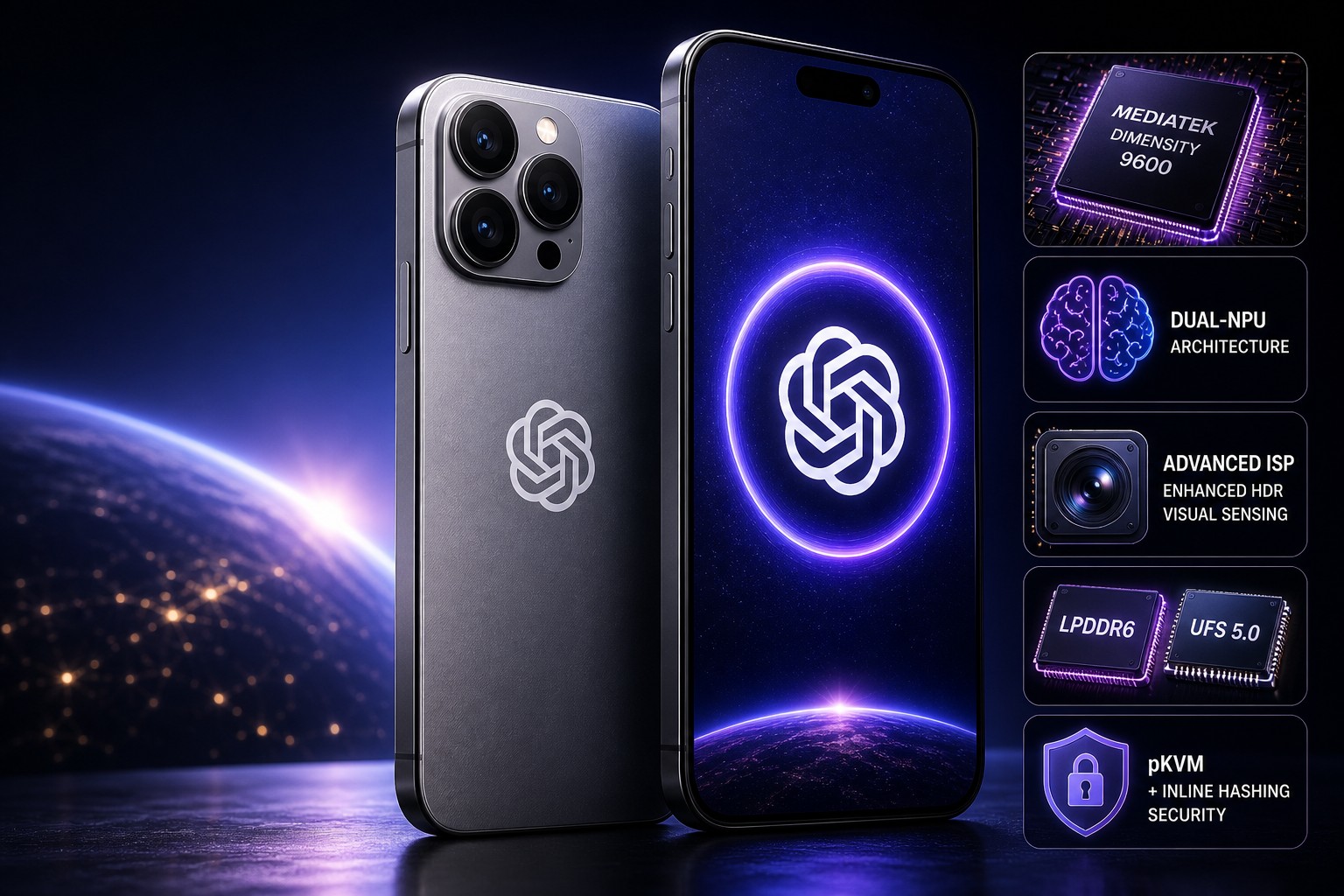
According to Kuo's post, OpenAI's 'AI agent phone' is targeting mass production as early as the first half of 2027, with a public launch likely in the fall of that year. He projects combined 2027–2028 shipments of around 30 million units. MediaTek is described as 'currently the frontrunner' as chipset supplier — not confirmed, not contracted, frontrunner. The specific chip cited is a customised version of the Dimensity 9600, which doesn't exist yet; the current flagship is the Dimensity 9500, which powers phones like the Vivo X300 and Oppo Find X9 Pro. The 9600 is expected to launch in Q4 2026. The reported specs around that chip: built on TSMC's N2P process node, LPDDR6 RAM, UFS 5.0 storage, a dual-NPU architecture, and security features including pKVM and inline hashing. Kuo also flags the ISP — the image signal processor — as 'the headline spec,' with an enhanced HDR pipeline described as improving 'real-world visual sensing.' Sam Altman has separately said now is the right time to 'seriously rethink how operating systems and user interfaces are designed,' and the device is described as working differently from a traditional smartphone by carrying out tasks directly rather than through app-based interactions. That's the full verified inventory of claims. Everything else circulating is extrapolation.
The Chipset Angle Is the Real Story — Here's Why
Most coverage is treating the 30 million units projection as the headline. The genuinely interesting signal is the dual-NPU architecture on a customised chip. Here's the analogy: when you tap your Touch 'n Go card at a highway toll, the transaction happens instantly because the processing is local — it doesn't need to call a server in KL Sentral to verify your balance. On-device AI works the same way. A phone with a capable NPU can run AI tasks — understanding your voice, analysing a photo, executing an agent instruction — without sending your data to a cloud server and waiting for a response. Faster, more private, works offline. Apple built its Neural Engine into the A-series chip starting in 2017. Google built its Tensor chip specifically to run on-device AI for Pixel phones. Both companies made the strategic decision that owning the silicon meant owning the AI experience. If OpenAI is building a customised version of the Dimensity 9600 with a dual-NPU architecture — meaning two separate neural processing units that can handle different AI workloads simultaneously, like vision and language at the same time — that's the same strategic logic. It means OpenAI wouldn't just be an app running on someone else's hardware. It would be an AI layer baked into the chip itself, which is a very different competitive position.
The Semiconductor Backdrop Makes This More Complicated
The OpenAI phone, if it materialises, is entering a semiconductor landscape that looked completely different 18 months ago. Two things have shifted fast. First, TSMC — which currently manufactures essentially all of Apple's A-series and M-series chips, and would be manufacturing the Dimensity 9600 on its N2P node — is under enormous capacity pressure. Nvidia's AI chip demand has made TSMC's advanced nodes a scarce resource, and Apple is TSMC's second-largest customer after Nvidia. The New York Times reported in February 2026 that federal officials have for years warned Silicon Valley about the risks of concentrating 90 percent of the world's high-end chip production in Taiwan, with Treasury Secretary Scott Bessent calling it 'the single biggest point of single failure' in the world economy. Second, Apple and Intel have reportedly reached a preliminary agreement that would see Intel manufacture some Apple chips — a significant shift given Apple has relied solely on TSMC for its most advanced silicon. Intel's new fabrication plant in Chandler, Arizona is now in high-volume production on its 18A node, designed to rival TSMC's 2nm process. Analyst Ben Bajarin of Creative Strategies told CNBC: 'Intel is the only place that can scale up capacity as a viable second source.' This matters for the OpenAI phone because the Dimensity 9600 is also targeting TSMC's N2P node — meaning OpenAI, Apple, and every other company chasing 2nm-class silicon in 2026 and 2027 are all competing for the same constrained manufacturing capacity.

Sources
- [1]OpenAI smartphone leak reveals next-gen chipset and more details — Notebookcheck
- [2]OpenAI’s new phone being fast-tracked to launch next year, per report — 9to5Mac
- [3]Weekly Tech Wrap: Instagram Kills 'Followers', OpenAI Phone, Pixel 11 Specs, Vivo X300 Ultra, OnePlus Nord CE 6 — NDTV Profit
- [4]OpenAI AI Phone: Leaked Specs, 2027 Release Date, 2nm Chip — nokiapoweruser.com
- [5]OnePlus 16 leak reveals 200MP zoom camera, new chipset and large battery — Notebookcheck
- [6]iQoo 15T: First look at new flagship with 200MP camera leaked — Notebookcheck
- [7]Xiaomi phone with 7-inch display and 10,000mAh battery leaks alongside launch window — Notebookcheck
- [8]OnePlus Nord CE6 offers 8,000 mAh battery and IP69K at mid-range pricing — Notebookcheck
- [9]Intel shares soar on Apple chip deal report. Here's why it signals a total pivot for chipmaking — CNBC
- [10]Apple and Intel Reach Preliminary Chip Manufacturing Deal — SQ Magazine
- [11]Apple Is Exploring Intel and Samsung as US Chip Foundries for Its Main Processors and the Edge-AI Implications Go Far Beyond Reshoring Politics — Startup Fortune
- [12]The Looming Taiwan Chip Disaster That Silicon Valley Has Long Ignored — The New York Times
- [13]Intel Stock Sinks After Analysts Question Apple Deal Timeline — The Tech Buzz
- [14]Nvidia resets the economics of AI factories, again — SiliconANGLE
Comments
No comments yet — be the first to weigh in.