If AI Writes the Code, Does the Language Still Matter? The Case For and Against Python's Dominance
AI code generation is quietly reshaping which programming languages win — and Python's lead is more fragile than it looks.

The Question Nobody Was Asking Two Years Ago
Here is a scenario that is becoming genuinely common: a developer opens an AI coding assistant, describes what they want in plain English, and gets back working code — in a language they have never formally studied. If that is the new normal, the old logic of 'learn Python because everyone uses Python' starts to wobble. The Hacker News thread asking 'If AI writes your code, why use Python?' attracted 767 comments not because the answer is obvious, but because it genuinely is not. The interesting question is not whether Python survives — it almost certainly does in some form — but whether the specific advantages that made it dominant are still the ones that matter when an AI is doing the typing. To understand why this is unsettled, you need to understand how Python got here in the first place.
How Python Built Its Moat — And What the Moat Is Actually Made Of
Python's dominance is not primarily a story about the language itself. According to Simplilearn's 2026 programming language guide, Python holds a 29.7 percent global share on GitHub, and its position is built on three reinforcing pillars: readability that lowers the barrier to entry, a vast ecosystem of libraries for AI and data science, and the simple fact that it became the default language taught to new developers entering those fields. IEEE Spectrum's 2025 Top Programming Languages ranking notes that fundamental shifts in how people code are now forcing a re-examination of these rankings — a signal that the assumptions baked into Python's lead are under pressure. The honest breakdown is this: some of Python's moat is genuine language advantage — its syntax is genuinely readable. But a large portion is network effect. Everyone uses it because everyone uses it, which means tutorials, Stack Overflow answers, and open-source ML libraries are all written in Python. That second part of the moat is exactly what AI code generation threatens to drain.

The Real Disruption: AI Lowers the Cost of Using an Unfamiliar Language
The traditional argument for sticking with Python ran something like this: switching languages is expensive because your team needs to learn new syntax, new idioms, and new tooling. AI code generation attacks that cost directly. When a developer can describe intent in plain language and receive working Rust, Go, or TypeScript, the 'everyone knows Python' network effect erodes faster than most people expect. Simplilearn's 2026 guide explicitly flags that Rust, Go, Kotlin, and TypeScript are gaining ground precisely because teams want software that runs faster, stays secure, and scales — properties Python has always traded away for convenience. The shift is not that Python becomes bad. It is that the switching cost, which was the main reason to stay even when another language was technically better for a task, gets compressed. VS Code's dominance — 75.9 percent market share according to tech-insider.org's 2026 comparison — matters here too: its 55,000-plus extension ecosystem and multi-language support mean the tooling argument for staying in a single-language environment is also weakening.

Which Languages Actually Get Better With AI — and Which Get Worse
This is where the analysis gets genuinely interesting, and where a critical piece of evidence lands hard. Veracode's 2025 GenAI Code Security Report tested more than 100 LLMs across over 80 coding tasks and found that AI models generated insecure code 45 percent of the time when not given specific security instructions. Crucially, performance varied by language: Java produced insecure AI-generated code at a rate of 71.50 percent — significantly worse than Python, C#, and JavaScript, which performed similarly to each other. Veracode's researchers attribute Java's poor result to its long history: more insecure legacy Java code exists in AI training data, so the models learned insecure patterns. This is the dynamic that determines which languages benefit from AI assistance. Typed languages with strong Language Server Protocol support — TypeScript is the clearest example — give AI models precise feedback about what is structurally valid, which reduces hallucinated idioms. Languages with formal, stable specifications give models a reliable ground truth. Dynamic, convention-heavy ecosystems where 'correct' code depends on community norms rather than compiler enforcement are exactly where AI models hallucinate most confidently. Python sits uncomfortably in the middle: readable enough that AI output looks plausible, but dynamic enough that subtle errors and insecure patterns slip through without a type system to catch them.
The Security Blind Spot That Changes the Calculus
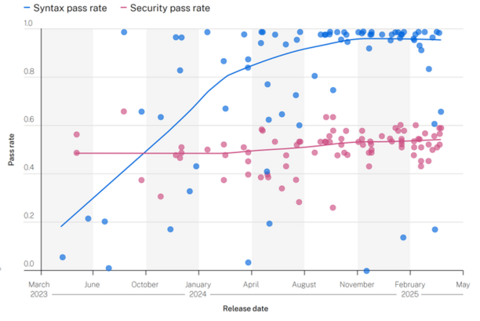
Veracode's research surfaces a detail that reframes the entire language debate: despite LLMs improving at generating syntactically correct code over time, their security performance has not improved at all. The models got better at writing code that compiles and runs — they did not get better at writing code that is safe. Specific vulnerability categories are alarming: AI-generated code contained cross-site scripting weaknesses in 86.47 percent of relevant tasks, and log injection weaknesses in 87.97 percent of tasks, when no security-specific instructions were provided. Veracode's CTO Jens Wessling described this as 'vibe coding' — developers relying on AI to generate code without explicitly defining security requirements, effectively leaving secure coding decisions to models that make the wrong call nearly half the time. For the language choice question, this matters because languages with stronger type systems and compiler-enforced constraints catch a class of these errors automatically. A language where the toolchain itself rejects unsafe patterns is structurally safer in an AI-assisted workflow than one where safety depends on the developer knowing to ask the right question.
What to Watch Next
Three developments are worth tracking closely. First, whether context engineering — Anthropic describes it as 'the art and science of curating what will go into the limited context window' during AI inference — matures to the point where AI coding agents can maintain enough project context to consistently apply language-specific security idioms, not just syntax. Second, whether the 71.50 percent insecure code rate for Java improves as AI training datasets are curated more carefully, or whether legacy-heavy languages are structurally disadvantaged in AI-assisted development for years. Third, watch TypeScript adoption curves relative to JavaScript: TypeScript's type system is exactly the kind of formal constraint that helps AI models generate more reliable code, and if developers start choosing languages partly based on how well AI tools perform in them, that feedback loop could accelerate language shifts faster than any previous technology transition. Python's ecosystem is real and deep — but ecosystems have shifted before when the cost structure of the underlying technology changed.
Sources
- [1]Effective context engineering for AI agents — Anthropic
- [2]Best Programming Languages to Learn in 2026 — Simplilearn.com
Comments
No comments yet — be the first to weigh in.