Paydibs Just Plugged Directly Into PayNet. Here's Why That's a Bigger Deal Than It Sounds for Malaysian Merchants
A direct PayNet connection changes the economics of QR payments — and small merchants feel it most.
The Hidden Cost Every Merchant Pays Without Knowing It
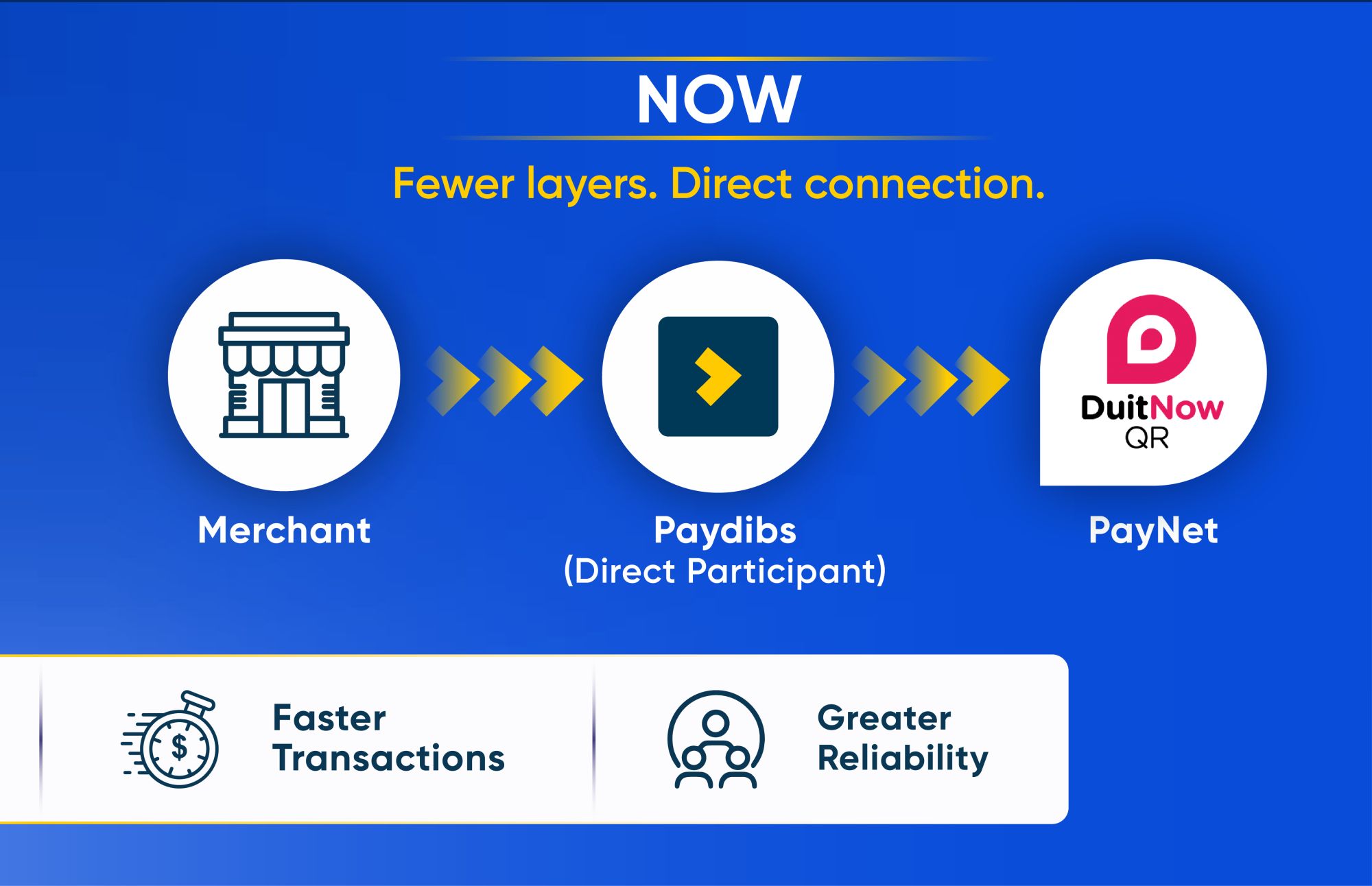
Picture a nasi lemak uncle in Chow Kit. He sticks a DuitNow QR code on his stall, customers scan and pay, money appears in his account. Simple, right? But underneath that scan, there's a chain of middlemen — and every link in that chain takes a small cut and adds a small delay. Most merchants have no idea this chain even exists, let alone how long it is. That's exactly why Paydibs becoming a direct participant with Payments Network Malaysia (PayNet) for DuitNow QR acceptance matters. It's not a press release milestone. It's a structural change to how many hops a payment takes before it reaches a merchant's account — and fewer hops means lower costs, faster settlement, and less that can go wrong in between.
What 'Direct PayNet Participant' Actually Means (No Jargon, Promise)
Think of PayNet as the PLUS Highway of Malaysian payments — the national backbone everything runs on. Most payment providers don't connect to this highway directly. Instead, they go through an acquirer, which is like a toll plaza operator who handles the connection on their behalf. That acquirer charges for the service, adds a processing layer, and controls the timing of when funds move. When Paydibs was not a direct participant, it relied on this kind of intermediary for DuitNow QR. Now, it connects straight to the PayNet highway itself. According to Paydibs, this direct participation improves cost efficiencies, gives merchants better cash flow visibility, and delivers quicker access to funds. CEO Tee Kean Kang put it plainly: the integration enables 'faster settlements, greater control and more efficient payment operations for businesses.' Paydibs had already done this for FPX (online banking payments) — the DuitNow QR connection completes the picture, giving merchants unified access to both payment rails through a single platform. --- **Plain-speak box: Key terms decoded** - **PayNet** — Payments Network Malaysia, the national infrastructure that runs DuitNow QR, FPX, and other payment rails. - **Direct participant** — A company connected straight to PayNet's network, not routed through another institution. - **Acquirer** — A licensed entity that processes card or QR payments on behalf of merchants. Can be an intermediary between a payment provider and PayNet. - **FPX** — Financial Process Exchange, the backbone for online banking transfers in Malaysia. - **Settlement** — When the money from a transaction actually lands in the merchant's account.
What This Means for Merchants Comparing Their Options
Here's the honest question a merchant should ask: when I accept a DuitNow QR payment through my provider, how many hands does my money pass through before it reaches me? For Paydibs merchants, that answer just got shorter. The company says direct participation delivers faster settlements and greater control over transaction processing. For a small business managing daily cash flow — think a pasar malam vendor or a small F&B operator — the difference between same-day and next-day settlement isn't trivial. It's whether you can restock ingredients tomorrow morning. Paydibs also highlights that merchants now get access to DNQR across banks and e-wallets through a single platform, alongside FPX. That's meaningful simplification: one integration, one dashboard, two major payment rails covered.

This Isn't a One-Off Move — A Pattern Is Forming
Paydibs isn't the only player making this move. In March 2026, MCash also joined PayNet as a direct participant, enabling DuitNow QR payments and DuitNow transfers for its users. The MCash integration similarly expanded interoperability, allowing its users to pay at merchant touchpoints beyond the MCash network. Two direct PayNet integrations within roughly two months signals something deliberate happening at the infrastructure level of Malaysia's payments ecosystem. More providers connecting directly to PayNet's rails means more competition on the merchant-facing layer — which historically puts downward pressure on fees and upward pressure on service quality. For merchants who've long been price-takers in a system controlled by a handful of large acquirers, that shift in bargaining power is worth watching.
What to Watch Next
The immediate question is whether Paydibs passes the cost efficiency gains through to merchants in the form of lower transaction fees, or absorbs them as margin. The company has signalled improved cost efficiencies but has not published specific fee changes in the available announcements. Watch for that. The broader trend to track: as more payment service providers pursue direct PayNet participation, the acquirer layer in Malaysia's payments stack faces structural pressure. Providers that can offer direct-rail speed and pricing — while bundling FPX and DuitNow QR in one platform — will have a compelling pitch to SME merchants currently spread across multiple payment solutions. Malaysia's QR payment ecosystem is quietly being rewired from the bottom up. The nasi lemak uncle might not notice the plumbing change, but he'll notice when his money arrives faster.
Sources
- [1]Paydibs strengthens paynet ecosystem participation with direct DuitNow QR access — The Star | Malaysia
- [2]Paydibs gets direct DuitNow QR connectivity — SoyaCincau
Comments
No comments yet — be the first to weigh in.