3D Printing Basalt for Mars Is Wilder Than It Sounds — And the Engineering Is Actually Solid
Volcanic rock, a 3D printer, and a strict power budget might be the most practical path to keeping humans alive on Mars.
The Problem With Bringing Your Own Walls to Mars
Here is the engineering puzzle that keeps Mars habitat designers up at night: radiation on Mars is brutal. Without Earth's magnetic field and thick atmosphere acting as a shield, the surface is constantly bombarded by cosmic rays and solar particle events that would make long-term human habitation genuinely dangerous. The obvious solution — ship shielding material from Earth — runs straight into the most punishing cost in the universe: getting mass off Earth's surface. Every kilogram you launch costs a staggering amount of energy and money. So the question flips. Instead of asking 'what's the best shielding material we can bring?', the smarter question becomes: 'what's already on Mars that could do the job?' That reframe is the entire foundation of in-situ resource utilisation, or ISRU — the principle that the best building material for an off-Earth habitat is whatever the destination planet already has lying around. And it turns out Mars has a lot of one particular thing: basalt.
Why Volcanic Rock Is Surprisingly Good at Stopping Radiation
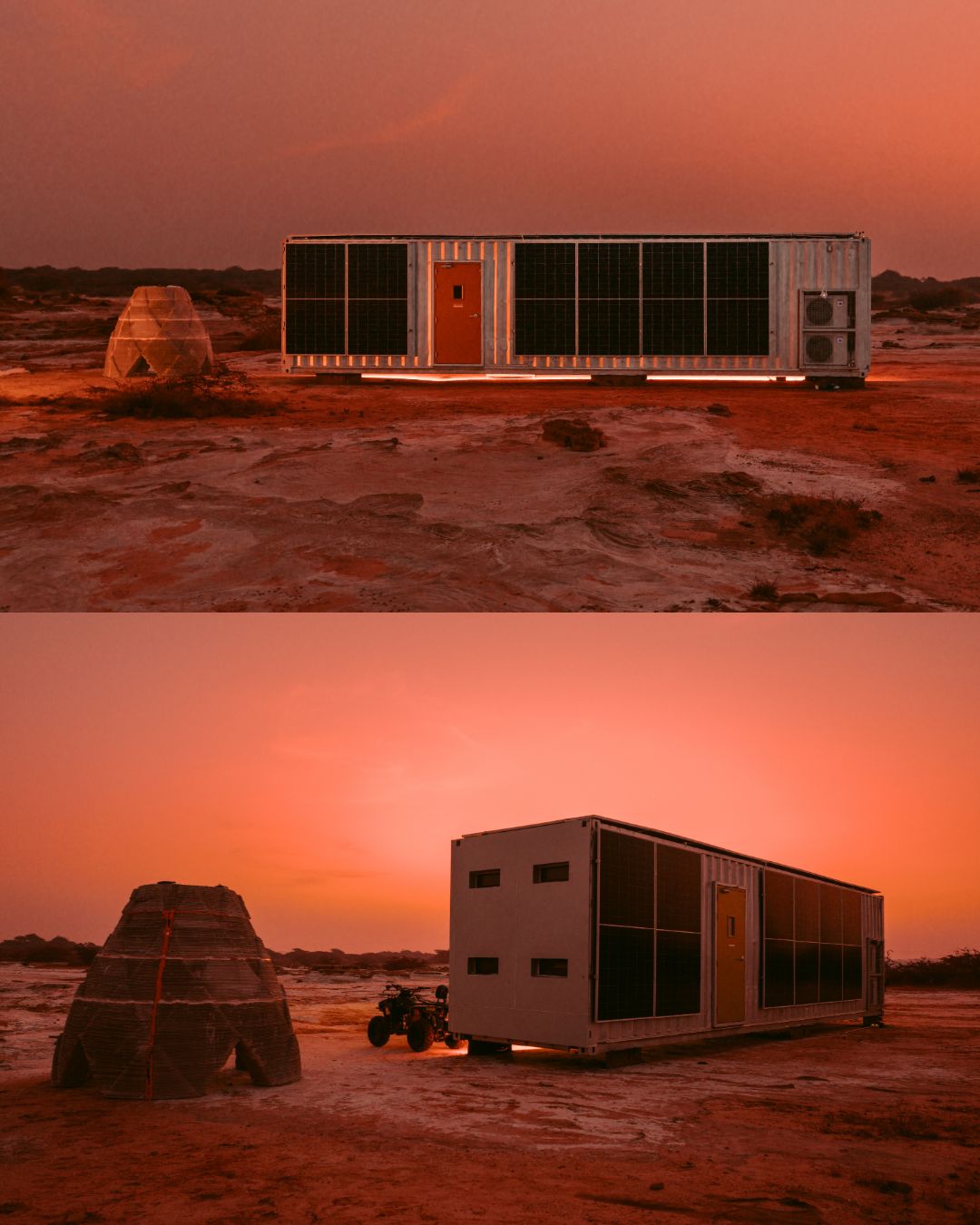
Basalt is not an exotic material. It is the same dense, dark volcanic rock you find in abundance on Earth — and it covers vast regions of the Martian surface. What makes it interesting as a radiation shield is a combination of its density and its elemental composition. Dense materials are effective at attenuating radiation because they present more atomic mass for incoming particles to interact with and lose energy in. Basalt's mineral makeup, rich in heavier elements, gives it genuine stopping power against the kinds of radiation Mars throws at you. Beyond shielding, basalt has structural credentials too. It is hard, thermally stable, and does not require complex chemical processing to be useful — properties that matter enormously when your manufacturing facility is 225 million kilometres from the nearest hardware store. AAKA Space Studio has been exploring exactly this combination of properties, developing 3D printed basalt structures designed to function as both radiation shields and structural components for analog habitat modules.
The Low-Power Constraint Is the Most Interesting Part of This Story
Designing a 3D printer for Mars is not simply a matter of shrinking down an Earth-based machine and shipping it. The binding constraint is power. Mars-available energy — whether from solar panels operating under weaker sunlight or from small nuclear sources — is limited and precious. Every watt your fabrication process consumes is a watt not available for life support, communications, or science. This forces a fundamental rethink of how the printing process itself works. Conventional high-temperature manufacturing approaches that might work fine in a factory on Earth become problematic when your power budget is tight. The engineering challenge AAKA Space Studio is working through is designing a fabrication pathway for basalt structures that can actually run within the energy envelope Mars realistically offers. That constraint — not the material science, not the printer mechanics — is what makes this genuinely hard and genuinely interesting. It pushes designers toward low-energy processing methods and printing geometries that achieve structural and shielding performance without demanding power the mission cannot afford.
ISRU: The Bigger Idea Behind the Basalt Printer
The basalt printing work sits inside a much larger strategic shift in how space agencies and private ventures think about off-Earth construction. ISRU — in-situ resource utilisation — is the formal name for the principle that sustainable presence beyond Earth depends on using local materials rather than resupply chains from home. Think of it this way: the first settlers anywhere had to build with what was around them, not wait for deliveries. Mars colonisation faces the same logic, just with a 20-minute communication delay and no possibility of a quick resupply run. Basalt is compelling within the ISRU framework because it requires relatively minimal processing compared to, say, extracting metals or synthesising polymers from Martian atmosphere. The rock is there, it has useful properties, and the processing chain from raw material to printed structure is shorter than most alternatives. AAKA Space Studio's analog habitat module work — combining 3D printed basalt radiation shields with habitat structures — represents a practical test of whether this chain can be made to work within real mission constraints.
What to Watch Next
The critical next steps for this technology are not about proving basalt works as a material — the physics there is reasonably well understood. The open questions are about process engineering at scale: Can the low-power printing approach produce structures fast enough to be mission-practical? How does print quality hold up when the feedstock is Martian basalt with natural compositional variation rather than a controlled Earth-sourced powder? And how do the finished structures actually perform under simulated Martian radiation conditions rather than in modelling? AAKA Space Studio's analog habitat work is an early-stage answer to some of these questions, but the gap between a prototype and a structure that keeps humans alive on Mars is substantial. The low-power constraint will remain the sharpest filter — any fabrication approach that cannot survive that test, regardless of how elegant the material science is, does not make it onto the mission manifest.
Sources
- [1]A Low-Power Path to Mars Radiation Shielding Made With Innovative 3D Printed Basalt Structures — 3D Printing Industry
Comments
No comments yet — be the first to weigh in.