Your Body Has a Default Breathing Mode — and Modern Life Has Almost Certainly Broken It
The science of why you're breathing wrong, and what a corrected breath actually looks like.
The Alarm Clock Starts It. The Desk Chair Finishes It.
Here's a small experiment: right now, without changing anything, notice where your chest moves when you inhale. If your shoulders crept upward and your upper chest expanded while your belly stayed flat — congratulations, you've just caught yourself doing what most adults do all day, every day, without realising it. This isn't a character flaw. It's a structural drift. As Yoga Journal's Donna Farhi put it in a piece that has aged remarkably well: "Beginning with the 'alarm' clock in the morning and ending with the drive through 'rush' hour traffic, our bodies face an extraordinary level of stimulation and acceleration." The human neuroendocrine system, she notes, has changed very little since the time of cave people — yet today we receive more stimulation in a single day than our ancestors likely encountered in their entire lifetime. The nervous system doesn't distinguish between a real threat and an imagined one. Farhi makes this precise: "Stress may be real or imagined — an important distinction for us to remember, but not one that the nervous system itself makes. Just imagining a stressful event can reduce inhalation volume." Stack enough of those days together, and shallow chest breathing stops being a response to stress. It becomes the default.
What 'Breathing Wrong' Actually Means — Structurally
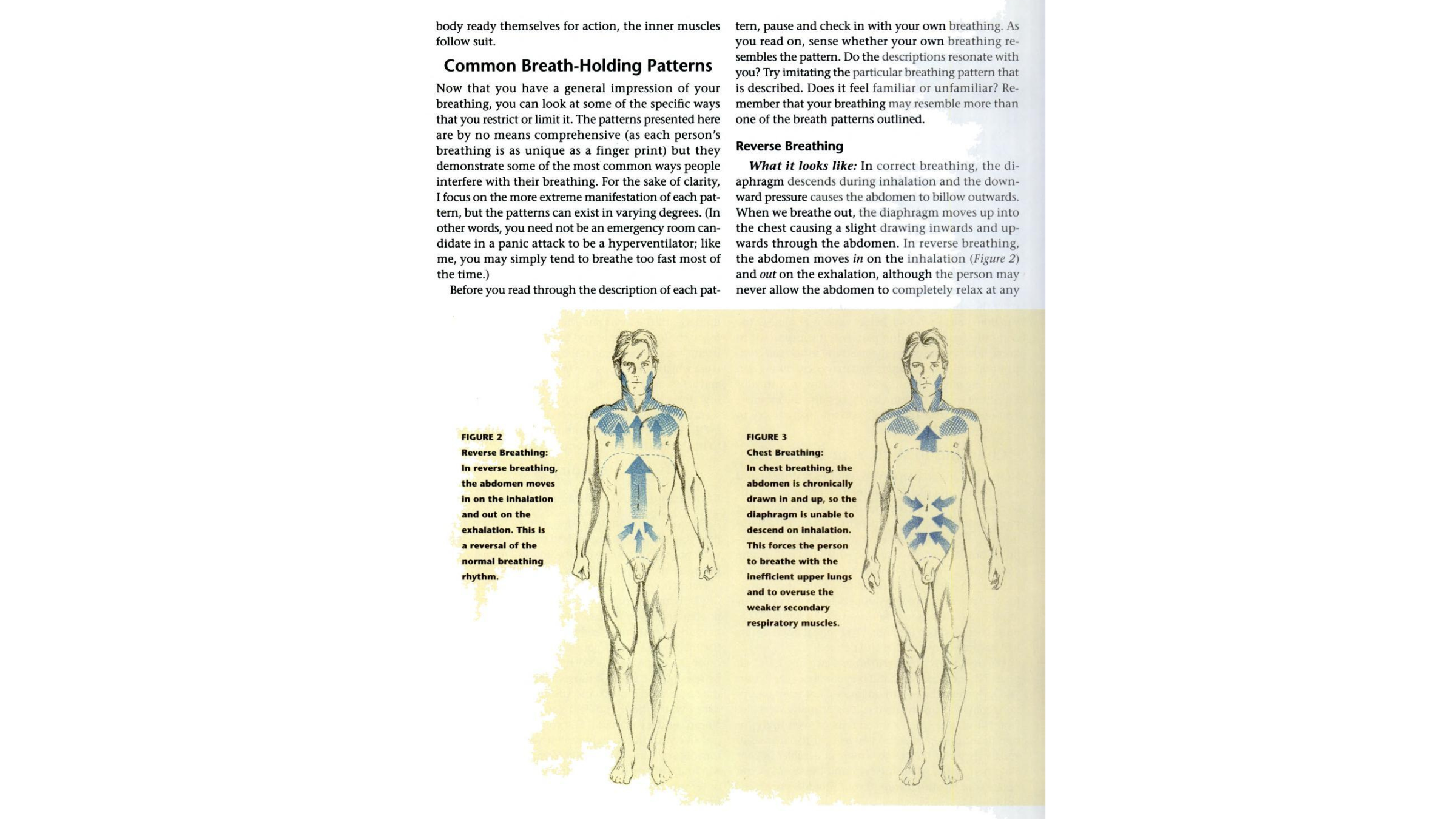
The phrase 'breathing wrong' sounds like wellness-influencer hyperbole. But there's a mechanical reality underneath it. Farhi describes several common breath-holding patterns that restrict the respiratory process — and the consequence isn't just reduced oxygen efficiency. When we obstruct our breathing, she writes, "we cut ourselves off from the most accessible and readily renewable source of energy a human being has." The deeper problem is habituation. When the body is exposed to continual stress over time, "the body can literally forget how to relax. The stage is set for a habituated stress response that keeps us tense regardless of whether we have any reason to be so." In other words, your breathing pattern stops being a real-time report on your current situation and becomes a fossil record of past stress. As Farhi puts it: "How we breathe may become more a statement about what happened to us in the past than what is happening to us in the present." This is why correcting breath mechanics isn't simply about taking deeper breaths occasionally. The underlying holding patterns — the muscular habits that constrict the ribcage, elevate the shoulders, and flatten the belly — need to be identified and dismantled first. Pranayama practice, Farhi cautions, can paradoxically be used to suppress these deep-seated patterns rather than resolve them. 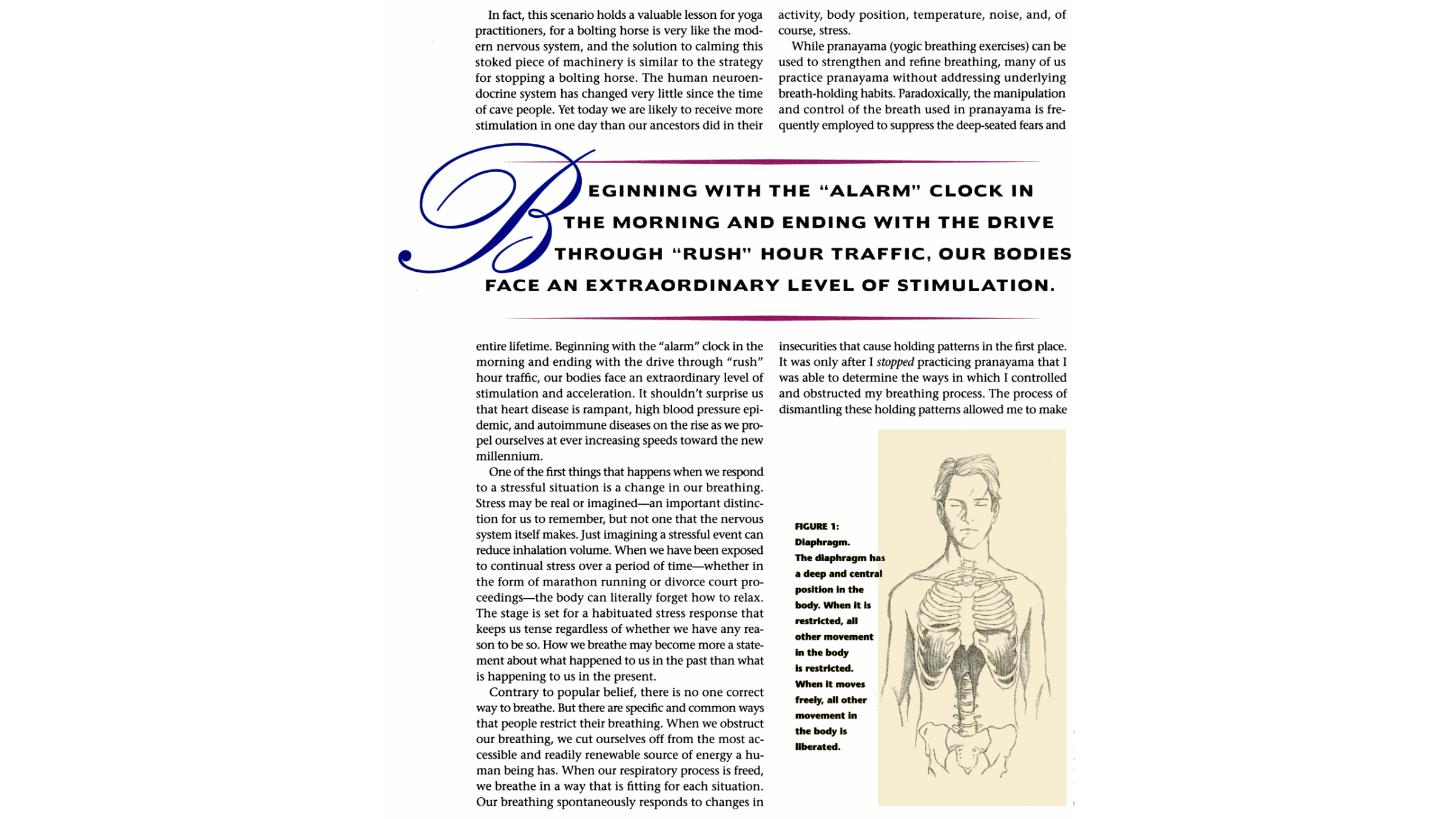 *(Photo: Yoga Journal, 1996)*

The 'Dead Butt' Parallel: When a Major Muscle Forgets Its Job
The respiratory muscle disuse problem has a surprisingly useful analogy in sports medicine: gluteal amnesia, colloquially known as dead butt syndrome. The parallel is structural, not just rhetorical. According to Runner's World, dead butt syndrome occurs when the gluteal muscles — particularly the gluteus medius and maximus — "essentially 'forget' how to do their job." This happens when prolonged sitting causes them to "switch off," becoming numb or underactive. The consequences don't stay local: the pain shows up in muscle groups that are being overworked to compensate, like the lower back. Coach Amie Dworecki describes it plainly: "Your butt forgets how to be a butt." The mechanism maps cleanly onto respiratory muscle disuse. A major muscle group — in the glute case, the gluteus maximus, potentially the strongest muscle in the body — weakens not from injury but from chronic non-use. Modern life simply never demands its full engagement. Physical therapist Anuja Ghate notes that the resulting dysfunction is cumulative: "It starts off as a slight discomfort that goes away and then eventually becomes persistent and more constant." The fix in both cases follows the same logic: not occasional exercise, but deliberate pattern-level retraining. The muscle hasn't been destroyed — it's been functionally switched off. The intervention is re-engagement, consistently enough to rebuild the neural habit.

Slowing Down Is a Physiological Act, Not Just a Philosophy
There's a reason meditation traditions, yoga lineages, and military stress-inoculation protocols have all converged on the same basic intervention: slow the breath down. This isn't coincidence, and it isn't mysticism. Mindfulness scholar Andrew Olendzki, writing in Mindful, is direct about the mechanism: "Mindfulness practice is a way of re-training oneself to slow down in every way, and the rate of breathing is the most accessible way of doing this." Research cited in the same piece shows that long-term meditators display measurably slower respiratory rates than non-meditators. The broader cultural context matters here too. Psychotherapist Francis Weller's observation — "We live in a cult of terminal velocity. A type of mania that consumes us with constant motion" — describes the environment that produces dysfunctional breathing in the first place. The average person today, Mindful notes, consumes more information in a day than someone in the 15th century would have encountered in their entire lifetime. The nervous system is running a load it was never designed for, and the breath is the most direct lever available to modulate that load. Being able to slow down physiologically, Olendzki suggests, "might bring a degree of deliberateness to 'fast-paced' endeavors" — not by disengaging from the pace of modern life, but by maintaining a regulated internal state within it.
What Retraining Actually Looks Like
The good news is that breath retraining doesn't require a yoga studio or a meditation retreat. The mechanics are learnable, and the entry points are low-friction. Yoga Journal's framework starts with honest observation: count your breaths per minute while sitting quietly, without trying to alter anything. That baseline number tells you where your nervous system is currently parked. From there, the work is identifying specific holding patterns — the ways the body has learned to constrict the breath — and systematically releasing them. Farhi's caution about pranayama is worth taking seriously here: formal breathing exercises can be genuinely powerful, but if they're layered on top of unaddressed holding patterns, they risk reinforcing suppression rather than creating freedom. "When our respiratory process is freed," she writes, "we breathe in a way that is fitting for each situation. Our breathing spontaneously responds to changes in activity, body position, temperature, noise, and, of course, stress." That adaptive responsiveness — breathing that actually tracks your current situation rather than replaying old stress patterns — is the real target. It's less about achieving a specific technique and more about restoring the system's natural intelligence. The diaphragm, like the gluteus maximus, is a muscle. It responds to the demands placed on it. Place deliberate, consistent demands on it, and it remembers what it was built to do.
Sources
- [1]Even Runners Can Develop Dead Butt Syndrome, and Fixing It Is Good for Your Performance and Longevity — Runners World
- [2]How Slow Can You Go? — Mindful
Comments
No comments yet — be the first to weigh in.