The Case for Local AI Is Stronger Than the Benchmarks Suggest — Here's the Honest Version
Cloud AI is still the default. Here's why that assumption is cracking, and what it would take to break it.

Why Is Cloud Still the Default? (It's Not Because It's Better)
Here's a question worth sitting with: if local AI inference has genuinely matured into a production-viable workflow — which the evidence increasingly suggests it has — why does nearly every developer, knowledge worker, and enterprise still open a browser tab and send their prompts to someone else's server? The honest answer isn't performance. It's inertia, infrastructure assumptions, and a cost structure that hides its own complexity. Think of it like prepaid versus postpaid mobile plans. Postpaid feels easier — you just use it and pay later. But anyone who has actually done the math on their telco bill knows the per-unit cost is rarely in your favour. Cloud AI works similarly. The subscription or per-token fee feels manageable until you're running it at scale, at which point the meter is always running. Local AI is more like buying the phone outright: higher upfront, but the per-call cost after that is zero. The SitePoint analysis of local versus cloud AI coding in 2026 frames the shift clearly: eighteen months of compounding progress brought local inference from a curiosity to a credible alternative, driven by aggressive model quantization, consumer GPUs shipping with 24GB or more of VRAM, and inference runtimes reaching stability. The question is no longer whether local AI works. It's why the default hasn't changed.

The Real Case for Local: It's Not Just Privacy
Privacy is the argument everyone leads with, and it's legitimate. A lawyer preparing a defence strategy cannot send case details to a third-party server without risking privilege. A developer working on proprietary code has real reasons to pause before hitting send. When your data leaves your machine, it passes through someone else's servers, subject to their retention policies and legal jurisdictions. But the privacy argument, while correct, undersells the actual case. There are three other pillars that matter more for day-to-day decisions. **Latency.** Cloud AI adds a round-trip to every inference call — your prompt travels to a data centre, gets processed, and the response travels back. Local inference eliminates that round-trip entirely. For agentic workflows where an AI is taking multiple sequential actions, that latency compounds fast. **No per-token cost at inference time.** Once local hardware is paid for, every subsequent query is free. The SitePoint analysis frames total cost of ownership over twelve months as a genuine differentiator — the cloud meter never stops running, while local amortises the hardware cost across every query you run. **Offline capability.** Cloud AI requires a stable connection. Local AI works on a plane, in a basement, during an outage, or in any environment where sending data externally is restricted. As InfoWorld notes, edge AI solves the latency, privacy, and cost problems that centralised cloud inference creates — and offline availability is a core part of that value. The TNGlobal analysis adds an energy dimension: a 2025 UNESCO and UCL report argued that using smaller, more task-specific models could reduce energy demand by up to 90 percent in some settings without sacrificing useful performance. Many business tasks — summarising documents, classifying tickets, rewriting text — don't need a frontier model at all.

The Real Blockers: What 'Runs' and 'Runs Well' Don't Mean the Same Thing
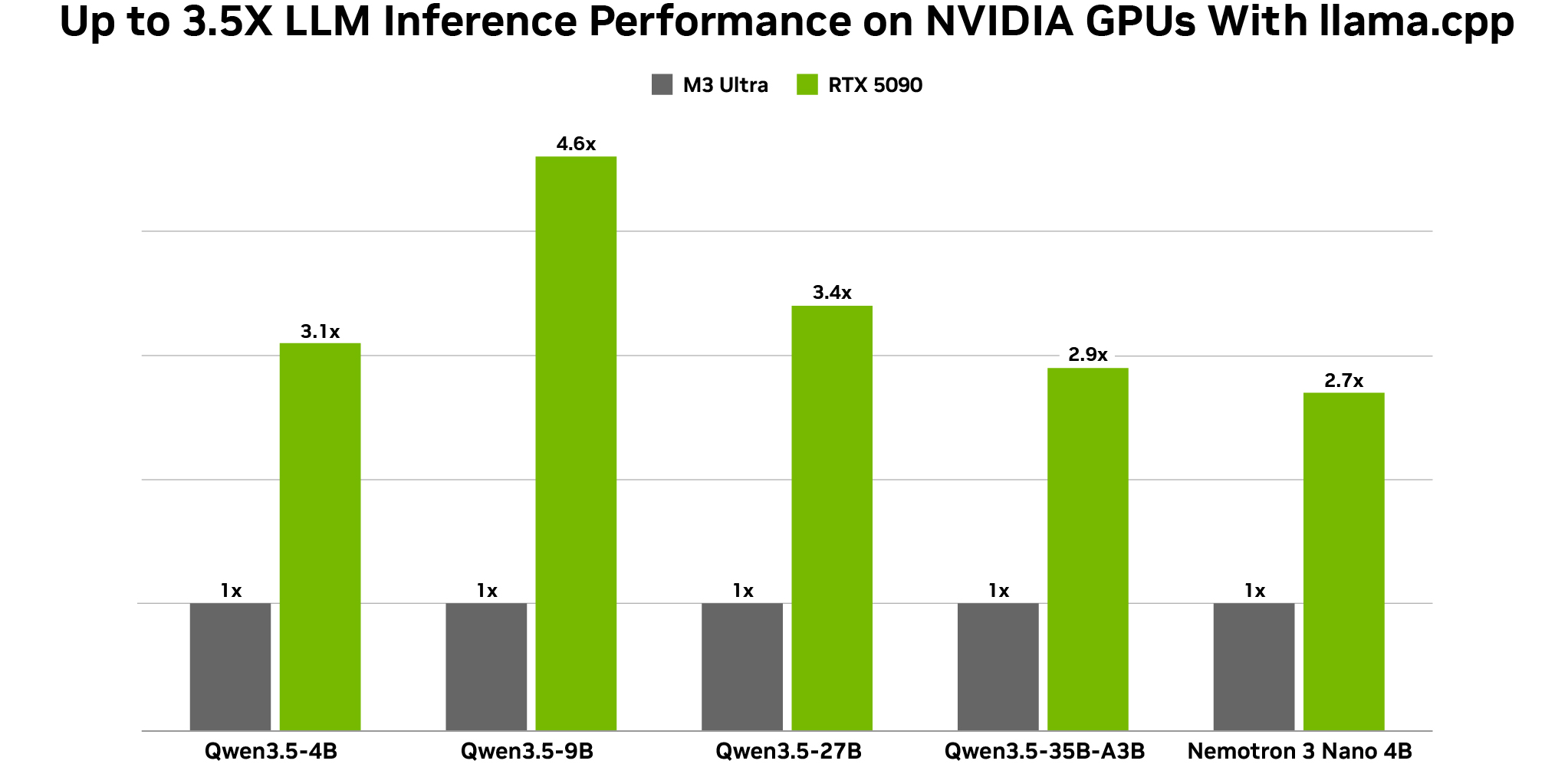
The honest version of this argument requires acknowledging where local AI genuinely falls short, because the gap between 'technically runs' and 'actually useful for production work' is still real. **Model update friction.** Cloud AI models update silently and continuously. You get GPT-5 improvements without doing anything. Local models require you to pull new weights, manage storage, and re-test your workflows. For a developer who wants to stay current, that's a non-trivial maintenance overhead. **Hardware cost amortisation.** The hardware that makes local AI genuinely capable isn't cheap. The RTX 5090 ships with 32GB of GDDR7. Apple's M4 Ultra has 192GB of unified memory. NVIDIA's DGX Spark, which supports models with more than 120 billion parameters via 128GB of unified memory, is positioned as a desktop AI supercomputer. These are not impulse purchases. The HP OMEN MAX 16 reviewed for local AI workloads costs nearly $7,000 AUD. The amortisation math works over time, but the upfront barrier is real. **The 'runs well' gap.** The SitePoint analysis is precise about this: the inflection point required mature software plus sufficient hardware arriving simultaneously. That combination — stable Metal and CUDA backends in Ollama, robust context window handling, plus 24GB+ VRAM consumer GPUs — only converged in early 2026. Before that, 'runs' often meant 'runs slowly, with caveats, on models too small to be genuinely useful.' **Security assumptions.** The Bleeding Llama disclosure (CVE-2026-7482) is a useful corrective to the idea that local automatically means safe. Ollama reportedly listens on all interfaces by default with no authentication. The vulnerability allows remote unauthenticated attackers to leak process memory — including user prompts, system prompts, environment variables, and API keys — through the model quantization pipeline, with roughly 300,000 internet-facing servers estimated to be at risk. Local inference is not inherently more secure than cloud; it just moves the attack surface.

Where Is the Inflection Point, Honestly?
The inflection point isn't the same for everyone, and conflating the knowledge worker, the developer, and the enterprise leads to bad conclusions. **For developers**, 2026 is already the inflection year, per the SitePoint analysis. The combination of GGUF quantization formats (Q4_K_M and Q5_K_M preserving meaningful quality), Ollama's maturity, and 24GB VRAM GPUs means local code completion is production-viable today. NVIDIA's Nemotron 3 Super — a 120-billion-parameter model with 12 billion active parameters — runs on the DGX Spark and RTX PRO workstations and scored 85.6% on PinchBench, making it the top open model in its class for agentic tasks. For a developer running repeated inference loops, the per-token cost saving and latency advantage are immediately tangible. **For knowledge workers**, the calculus is more nuanced. Canonical's Ubuntu AI strategy is instructive here: the company is making local inference the default, with cloud available only when explicitly chosen. That's a meaningful signal about where the general-purpose local AI experience is heading — but the rollout is gradual throughout 2026, and the features are still maturing. A knowledge worker on a standard laptop without a discrete GPU is not yet at the inflection point. **For enterprises**, the IDC prediction that 80% of CIOs will turn to edge services from cloud providers by 2027 to meet AI inference demands suggests the institutional shift is coming, but hasn't arrived. The ASUS Five-Layer AI City Architecture — spanning Sovereign Computing, Sovereign Models, Platforms, Applications, and Innovation — points to where enterprise thinking is heading: sovereignty over the compute layer, not just the data layer. Amazon hiking GPU prices 15% for certain ML workloads signals that cloud AI costs for inference at scale are becoming unpredictable, which accelerates the enterprise case.
What Would Actually Have to Change for Local to Win
The default stays cloud until three specific conditions shift. First, **hardware cost needs to fall another generation**. The current inflection hardware — 24GB+ VRAM GPUs, Apple M4 chips with large unified memory — is capable but expensive. The gap between 'capable enough for real work' and 'affordable for a standard knowledge worker budget' is still meaningful. One more hardware generation closing that gap changes the mass-market calculation. Second, **model update friction needs a solution**. The cloud's silent, continuous improvement is genuinely valuable. Local AI needs a credible answer to this — whether that's automated model management in runtimes like Ollama, or a layer that handles versioning the way a package manager handles software dependencies. Canonical's phased Ubuntu AI rollout is one attempt at this for the OS layer, but the broader ecosystem hasn't solved it. Third, **the security defaults need to harden**. The Bleeding Llama disclosure is a warning that local AI infrastructure is being treated as production infrastructure before its security posture matches that status. Ollama listening on all interfaces with no authentication by default is not acceptable for enterprise deployment. Until the defaults are secure, IT teams will rationally prefer the known risk profile of a vetted cloud provider over the unknown risk profile of a self-hosted runtime. The edge AI market is projected to reach $143 billion by 2034, per the InfoWorld analysis. The direction of travel is not in question. What's in question is the timeline — and for most users, the honest answer is that local AI is one hardware generation and one security maturity cycle away from being the rational default, not just the principled one. --- > **📦 Jargon-Free Explainer: Key Terms** > > **Quantization (GGUF Q4_K_M / Q5_K_M):** Compressing an AI model's size so it fits on consumer hardware, with some quality trade-off. Like compressing a video file — smaller, slightly lower fidelity, but watchable. > > **VRAM:** The dedicated memory on a graphics card. More VRAM means you can run larger AI models without them spilling over to slower system RAM. > > **Inference:** Using an AI model to generate a response. Distinct from training (teaching the model). Every time you send a prompt, that's inference. > > **Ollama:** A runtime that makes it easier to download and run open AI models locally. Think of it as the app store plus the engine for local LLMs. > > **Per-token cost:** Cloud AI providers charge by the 'token' — roughly three-quarters of a word. Long conversations or high-volume use adds up fast. > > **Agentic AI:** AI that takes sequences of actions autonomously, not just answering a single question. More inference calls per task means latency and cost multiply. --- **What to watch next:** Whether Ollama and similar runtimes harden their security defaults in direct response to the Bleeding Llama disclosure — that's the clearest near-term signal of whether local AI infrastructure is maturing fast enough to match its production ambitions. Watch also for the next Apple silicon generation and whether NVIDIA's consumer GPU line crosses 32GB VRAM at a mid-range price point. Those two hardware events, more than any benchmark, will determine when the inflection point arrives for knowledge workers.
Sources
- [1]Local vs Cloud AI Coding: Latency, Privacy & Performance Guide — SitePoint
- [2]ASUS Group Initiates AI City with Whole City Export Model, Mapping Out a New Smart City Blueprint — ASUS Pressroom
- [3]Canonical Unveils Ubuntu AI Strategy: Local Models, User Control, and Smarter Workflows — Linux Journal
- [4]Edge AI: The future of AI inference is smarter local compute — InfoWorld
- [5]Cloud LLM vs Local LLMs: Examples & Benefits — AIMultiple
- [6]Bleeding Llama shows local AI is no longer a hobby project with hobby-grade security — Startup Fortune
- [7]GTC Spotlights NVIDIA RTX PCs and DGX Sparks Running Latest Open Models and AI Agents Locally — NVIDIA Blog
- [8]Why small language models may be the greener path for applied AI — TNGlobal
- [9]The Case for Local AI Has Never Been Stronger — HackerNoon
- [10]HP OMEN MAX 16 Review: Is Local AI on a Laptop Viable in 2026? — Digital Reviews Network
Comments
No comments yet — be the first to weigh in.