Bambu Lab's Open-Source Problem Is Really a Power Problem
The best consumer 3D printer maker built its empire on open source — then started locking the doors.

You Bought the Printer. Do You Own It?
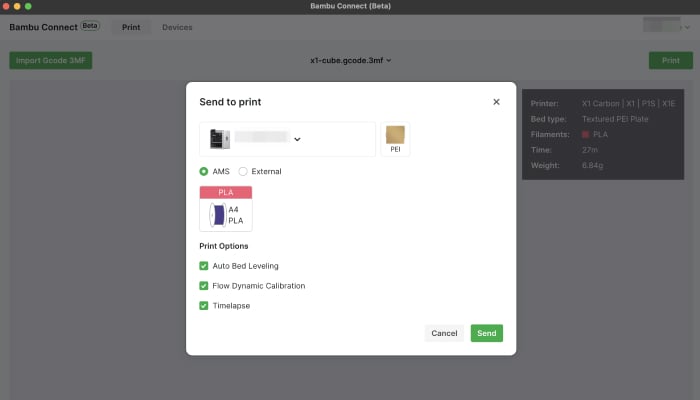
Picture this: you buy a piece of hardware, it works brilliantly out of the box, and the community around it is buzzing with third-party tools that make it even better. Then one day, the company pushes a firmware update — and suddenly, those tools don't work the way they used to. To get full functionality back, you now have to route everything through the company's own app. You either accept the new rules, or you freeze your device in time and never receive another update. That is exactly what happened to owners of Bambu Lab 3D printers in January 2025. Bambu Lab — widely regarded as making the best consumer 3D printers on the market right now — announced a firmware update that cut off OrcaSlicer's direct cloud printing feature. OrcaSlicer, a community-driven, open-source slicer that had become the gold standard for 3D printing software, could no longer send print jobs directly to Bambu printers. Users would have to go through a new middleware app called Bambu Connect instead. The community's reaction was immediate and loud — and the controversy has only grown since.
The Receipts: What Bambu Lab Took, and What It Gave Back
To understand why people are so angry, you need to follow the lineage of the software involved. OrcaSlicer is a fork of Bambu Studio. Bambu Studio is itself a fork of PrusaSlicer. And PrusaSlicer traces its roots back to the open-source Marlin firmware ecosystem that powered the RepRap movement — the original community that made consumer 3D printing possible in the first place. Because Bambu Studio uses PrusaSlicer's code as its foundation, it is bound by the AGPL-3.0 license — a "copyleft" open-source license that requires the core program to remain open source. Bambu Lab has complied with that requirement for the core of Bambu Studio. But here is the critical detail: the Networking Plugin — the component that actually lets Bambu printers talk to the cloud and to each other — is closed source. That is the engine room, and Bambu has kept it locked. OrcaSlicer was developed by SoftFever in 2022, when Bambu Lab was a young company with only one printer line. Because it was community-driven, it moved fast, shipping experimental features before Bambu's own software caught up. Bambu benefited enormously from this ecosystem — and then, once it had market power, began closing the very access that made it possible.
The Firmware Move That Crossed a Line
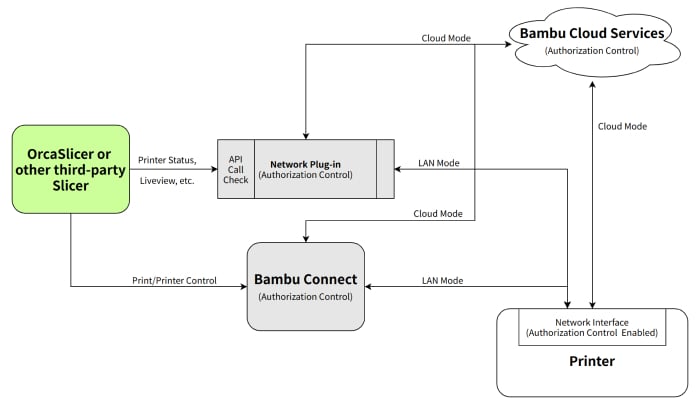
Bambu Lab's January 2025 firmware update introduced mandatory authentication and cloud routing for key printer functions: linking and unlinking printers from accounts, accessing live video, pushing firmware updates, launching print jobs via cloud or LAN mode, and controlling critical parameters like temperatures and calibrations. A "developer mode" was added in response to community backlash — but even that requires initialising through the cloud application first. Bambu's stated justification was security. The company reported receiving up to 30 million "unauthorized" requests per day to its servers, including DDoS attacks, with OrcaSlicer identified as the main source of that load. The new system routes OrcaSlicer connections through Bambu Connect as a bridge. The OrcaSlicer developers refused to build a two-app workflow into their software. That left users with a hard choice: update the firmware and lose OrcaSlicer's direct printing feature, or stay on old firmware and receive no future updates. Developer Paweł Jarczak then built a fork — OrcaSlicer-BambuLab — that restored the direct connection using only publicly available source code. Bambu Lab responded with a cease-and-desist threat, accusing Jarczak of impersonating Bambu Studio, bypassing authorization controls, violating their Terms of Use, reverse engineering their software, and enabling modified forks to send arbitrary commands to printers. Jarczak pulled the releases. He noted the irony: Bambu's own explanation acknowledged the connection path he used had simply not been disabled yet on the Linux side of their workflow.
The Broader Pattern: Bootstrap on Open Source, Then Close the Gate
What Bambu Lab is doing fits a recognisable playbook in the hardware startup world. Use open-source software to move fast and build a product when you have no resources and no community. Benefit from the goodwill, the bug fixes, the third-party integrations, and the ecosystem that open-source contributors build around your product for free. Then, once you have market dominance, introduce authentication layers, cloud dependencies, and legal threats that make it progressively harder for that same community to operate independently of your infrastructure. The community's leverage here is real but limited. The AGPL-3.0 licence does force Bambu to keep the core of Bambu Studio open. But the Networking Plugin — the part that actually matters for independent use — sits outside that obligation. Jarczak himself has already signalled where this ends up: he is pivoting his DIY multi-colour unit (BMCU) project away from Bambu's ecosystem entirely, moving to Klipper-based printers instead. That is the community's most credible form of leverage — not legal action, but exit.
What to Watch Next
Three things will determine how this plays out. First, watch whether Bambu Lab fully disables the Linux-side connection path that Jarczak's fork relied on — the company's own statement implied it was coming. Second, watch the Klipper ecosystem: if enough power users migrate away from Bambu hardware, it signals that locking down a maker-community product has a real cost in mindshare and word-of-mouth. Third, watch how the OrcaSlicer project itself responds — whether it forks away from Bambu compatibility entirely or finds a workable path through Bambu Connect. The deeper question this case is forcing into the open: can a hardware company extract full value from open source during its growth phase, then systematically close the ecosystem once it holds market power — and face no meaningful consequence? The 3D printing community is an unusually technical and vocal user base. How they answer that question will matter well beyond one printer brand.
Sources
Comments
No comments yet — be the first to weigh in.