Dayanita Singh Took Over a 500-Year-Old Archive in Venice — Without a Single Institutional Backer. Here's Why That Matters.
One Indian artist rewired how photography exhibitions work — and did it without the usual gatekeepers.
The Problem With One Photo on a Wall
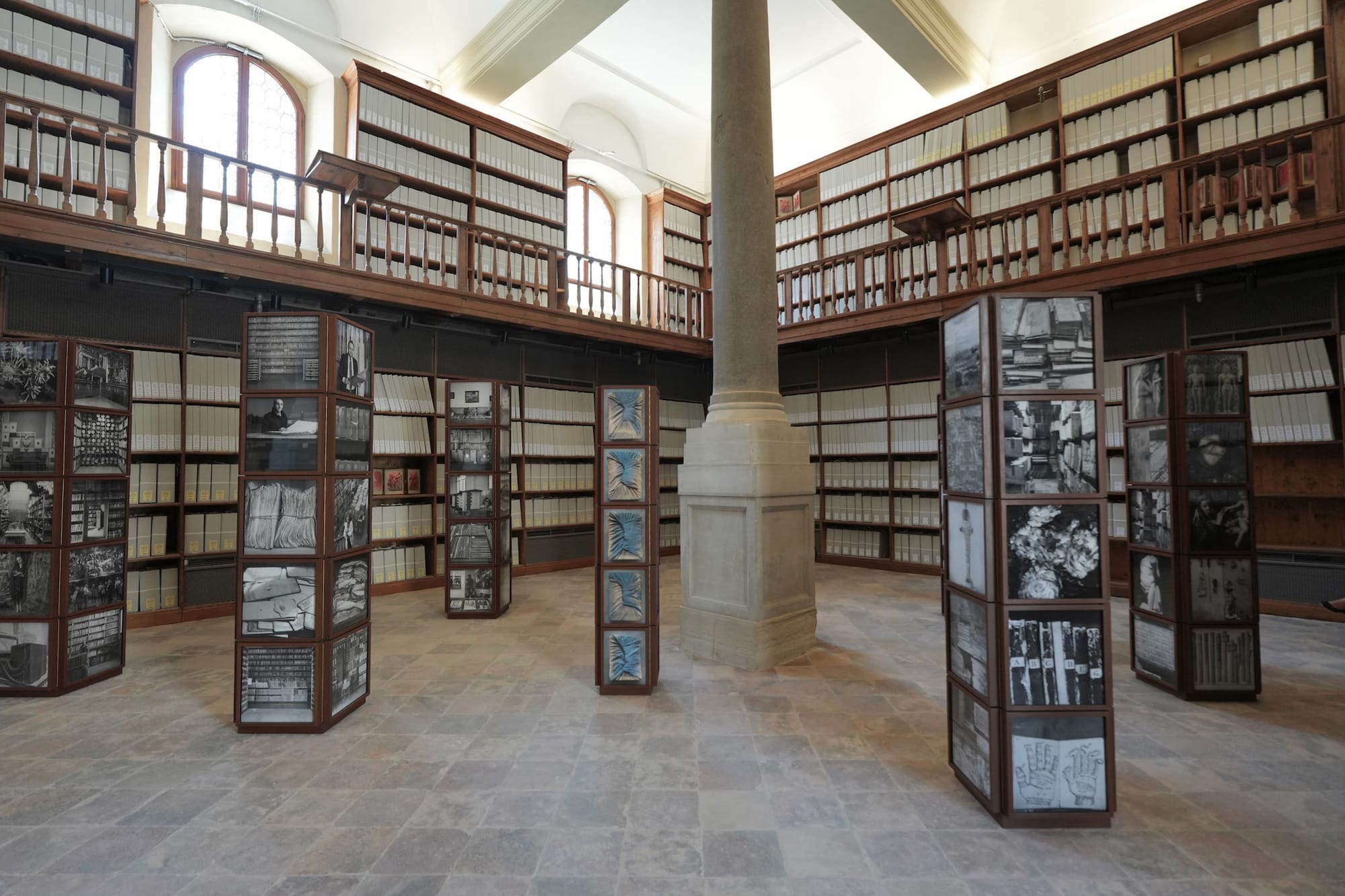
Think about the last time you scrolled through an Instagram grid versus the last time you held a physical photo album and felt the weight of sequence — the way one image pulled meaning from the one before it. That gap is exactly what has driven Indian artist Dayanita Singh for decades. She's been genuinely unsatisfied with what she calls the limitations of a single photograph placed on a wall. It's not a stylistic complaint. It's a structural one: the white-cube gallery format, she argues, strips photography of the relationships between images that give them depth. Her response has been to develop what she calls an 'off-set' practice — serialized formats, book objects, and custom collapsible wooden frames that turn an exhibition into something closer to a spatial argument than a display. ARCHIVIO, her current show at the State Archives of Venice, is the most ambitious version of that argument yet.
A 500-Year-Old Archive Opens Its Doors for the First Time
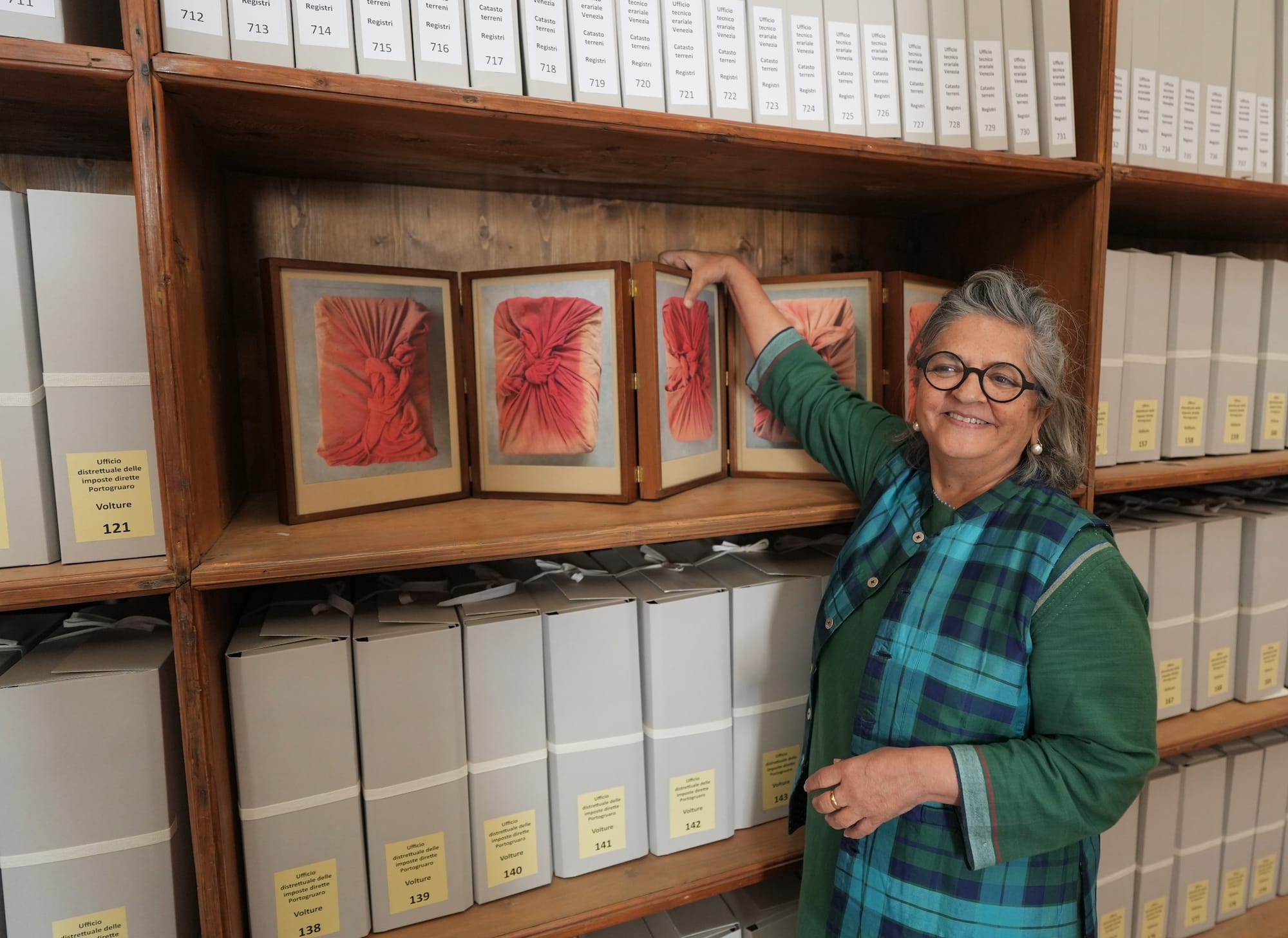
The State Archives of Venice, located in Campo dei Frari square in the San Polo neighbourhood, holds documents stretching back over a millennium — wills, contracts, official records that form the legal and civic memory of one of history's most storied cities. It has never, in its entire history, opened its doors to a public art exhibition. Until now. For ARCHIVIO, curated by Andrea Anastasio, Singh created collapsible wooden pillars covered with square-format, black-and-white images. The historical quality of the photographs is deliberate. But the real tension in the room is subtler: Singh includes images of Indian archival documents bound in brightly coloured cloths — cloths that fade through light exposure, leaving ghostly edges that researchers typically overlook. Placed inside a European archive built on the logic of permanent preservation, that fading becomes a statement. Not every archive treats memory the same way, and Singh's work makes that visible without announcing it.
The Friendship Economy: How She Actually Pulled This Off
The Venice Biennale runs on a well-understood prestige circuit: national pavilions, major gallery backing, institutional funding, PR machinery. Singh bypassed all of it. After setting herself the challenge of working without major institutional support, she bartered and negotiated her way into Italian archives from Naples to Venice, finding what she calls individual patrons who supported her vision. She negotiated with local art students, who serve as docents in exchange for her professional mentorship. 'It was an experiment to see if it was possible to really work with the friendship economy and make something outside the very commerce-driven biennale time,' she said. 'We couldn't afford PR, so I wasn't expecting anyone to come, and that's fine too. Even if nobody comes, I did it. But people are coming.' The show runs until July 31, after which it travels to Rome's Museo Nazionale Etrusco di Villa Giulia, Turin's Museo d'Arte Orientale, and finally the Istituto Italiano di Cultura in New Delhi — with each iteration connecting Singh's decades-long project to its specific site.
Why Photography Exhibitions Are Rejecting the Scroll
There's a reason Singh's approach feels increasingly urgent. Digital display has flattened photography into an endless feed — every image the same size, the same duration, the same context-free rectangle. The exhibition format was supposed to be the antidote, but the standard wall-hang model often replicates the same problem in physical space: isolated images, no sequence, no object-ness. Singh has spent her career building alternatives. As far back as 2018, she articulated the logic clearly: 'I knew that I could make my own systems, that I didn't have to depend on the distribution of the publishing world or the gallery world.' ARCHIVIO is where that conviction meets its most historically loaded setting. The spatial, sequential, and tactile experience she's built inside a millennium-old archive is a direct counter-argument to the scroll — one that requires presence, movement, and time to read properly. --- **JARGON-FREE EXPLAINER: What is an 'off-set' practice?** Singh uses this term to describe work that exists *off* the standard exhibition and publishing circuits. Instead of a single photograph on a gallery wall or a book distributed through conventional publishers, her 'off-set' formats include collapsible wooden frames that can be reconfigured, book objects designed as artworks in themselves, and serialized image sequences that only make sense as a whole. Think of it less like a painting hung in a frame and more like a playlist — where the order and the container are as meaningful as any individual track.
What to Watch Next
ARCHIVIO doesn't end in Venice. As the show travels to Rome, Turin, and New Delhi, each iteration will present works that connect Singh's project to its new host site — meaning the exhibition is itself a kind of living archive, accumulating context as it moves. Watch for whether the New Delhi iteration, at the Istituto Italiano di Cultura, sharpens the tension between Indian and European archival traditions that ARCHIVIO introduces in Venice. More broadly, Singh's friendship-economy model — patrons over institutions, mentorship over PR, negotiation over commission — is worth tracking as an alternative to the prestige-circuit default. Whether it scales, or whether it works precisely *because* it doesn't scale, is an open question.
Sources
- [1]How Dayanita Singh Organized a Major Show in Venice Without Institutional Funding — Hyperallergic - Contemporary Art
Comments
No comments yet — be the first to weigh in.